
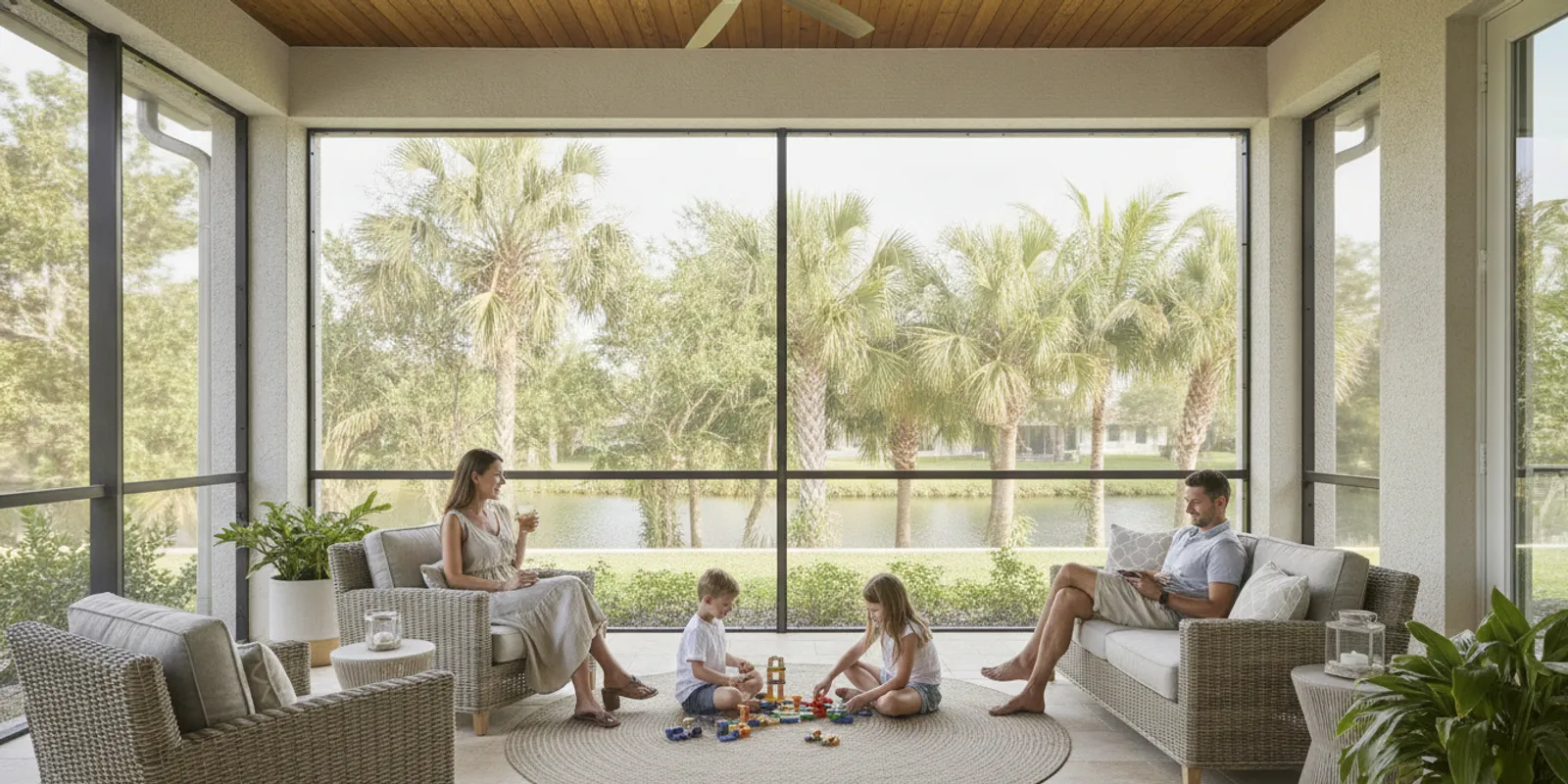
Choosing between Fortress or MagnaTrack hurricane screens starts with the opening, not the product name. A screen that suits a wide lanai may not be the right match for a smaller patio opening, and the operating method, appearance, and verified approval details matter as much as the label. Sun and Storm Systems installs both screen lines, but the product-specific facts and fit should be confirmed for your home before a decision is made.
Call to request a free on-site measurement and estimate
What should you compare first?
Start with the opening you want to address and how you use the space. A screen for a lanai that is open to the yard has a different job from one covering a doorway or a smaller patio bay. The size and shape of the opening influence what can be specified, how the screen will operate, and which details must be checked before installation.
Then separate confirmed product facts from assumptions. The name Fortress or MagnaTrack alone does not tell you the approved sizes, design pressures, anchoring requirements, available controls, or appearance of the screen in your particular opening. Nor does the fact that both are screen products mean that they share the same construction or limits. Ask for the exact product and configuration being quoted, and have the relevant specifications matched to the measured opening.
MagnaTrack is a motorized screen line. Sun and Storm Systems describes its MagnaTrack screens as helping keep out wind, rain, dirt, pollen, and insects, adding privacy, and allowing homeowners to manage lanai comfort; the screens can also be lowered for storm protection. The scope and performance for a particular home still depend on the product, opening, and installation details. For Fortress, confirm the exact system and its current product facts directly with the estimator rather than assuming it shares MagnaTrack’s features.
If you want a closer look at the MagnaTrack line, read the MagnaTrack screen overview for patios and lanais. Use it as background, not as a substitute for confirming which configuration is appropriate for your own opening.
A helpful starting point is to write down what you know and what you need to verify. For example, you may know that the opening is a wide lanai span and that you want a screen for everyday outdoor use. You may not know whether either proposed system is documented for that span, what attachment details apply, or how each one would look when retracted. Keep those unknowns visible instead of filling them with assumptions. A short list can keep the comparison fair: record the exact opening, your main use, the product facts supplied in writing, and any question still waiting for an answer.
It is also useful to distinguish a product’s general description from the actual scope of a quote. A brochure or website may introduce a product family, while the estimate identifies the model, dimensions, controls, and work proposed for one home. When those sources appear to differ, ask which document is current and which details apply to your project. The written proposal should resolve the differences before you approve anything.
How does the opening affect the choice?
Before comparing screen lines, make a simple inventory of the openings you want to cover. Note whether each one is a full lanai span, a patio section, a doorway, or another opening. Record the approximate width and height if you know them, but do not treat a homeowner measurement as the final specification. An on-site measurement is needed to assess the actual opening and the conditions around it.
Look at each opening separately. A home may have one broad span, several narrower bays, and a doorway with different framing. A system that works well in one place is not automatically the right choice everywhere else. The location of posts, tracks, adjacent surfaces, corners, overhead structure, and the way people move through the space can all affect what should be reviewed.
- Width and height: Ask what screen sizes are available for the exact system and whether the measured dimensions fall within its documented limits.
- Shape and divisions: Identify posts, corners, changes in level, or separate bays. Ask whether the proposal treats each section independently or as part of a larger arrangement.
- Mounting surfaces: Have the installer inspect the material and condition of the surfaces where the system would attach. Do not assume that two similar-looking openings have the same anchoring needs.
- Access and circulation: Consider doors, walkways, furniture, grills, and other features that may affect screen placement or everyday use.
- Exposure: Explain which sides of the lanai are open and how the space is used. The estimator can identify what project-specific information needs to be checked.
Size matters, but it is not the only sizing question. A dimension that appears to fit a product’s general range does not by itself establish that the full installation is approved for the opening. Product approvals can set limits on tested sizes, design pressures, and anchoring requirements. Those details must be checked against the particular product and installation, rather than inferred from a general description.
When you have several openings, ask whether the estimate identifies them individually. A clear opening-by-opening proposal makes it easier to see which system is proposed for each area and why. It also helps prevent a decision about one large span from being applied automatically to smaller or differently framed openings.
Imagine, for instance, that your lanai has a broad opening facing the yard and a narrow side opening beside a door. The broad span may raise questions about maximum documented dimensions and how the system attaches across the span. The side opening may raise different questions about clearance, the path of the door, and everyday access. Neither example points automatically to Fortress or MagnaTrack. Instead, they show why the estimator should record separate dimensions and explain the basis for the recommendation at each location.
A second useful example is a home with several openings that look alike from a distance but have different support conditions. One may have a solid mounting surface; another may include trim or a transition that needs closer review. Ask that the proposal note such differences, especially if they affect the product configuration or installation scope. If an opening cannot be assessed from the visible area alone, ask what additional inspection or documentation is needed before a final choice.
Do not rely on a rough measurement to compare products as if it settled the question. A homeowner’s dimensions help describe the project, but the site visit checks the actual width, height, geometry, and attachment conditions. If the measured opening changes the options, ask the estimator to explain that change and update the written comparison. This is more useful than holding to an early guess simply because it was the first number discussed.
How should operation factor into your decision?
Think about what you want the screen to do on an ordinary day. Will you use the lanai often? Do you want to change the amount of enclosure as weather or comfort needs change? Will someone need to operate the screen from a particular location? These questions help turn a general product comparison into a practical discussion about day-to-day use.
MagnaTrack is described as motorized. During the consultation, ask how the specific proposed configuration is controlled, where its controls would be located, and what the normal sequence of use looks like. Confirm the available operating details for the exact system being quoted; do not assume a control method, smart-home connection, or feature that has not been specified.
For Fortress, ask the estimator to explain the operation of the exact screen being considered. The information supplied here does not establish Fortress’s operating mechanism or control options, so those details should be confirmed from current product documentation and the proposal. If operation is an important deciding factor, ask to see or discuss the actual system rather than comparing brand names alone.
Consider who will use the screen and how often. A system that feels intuitive to one household may be less convenient for someone with different mobility, reach, or routine. Discuss whether you prefer a powered operation, what happens when the screen is not in use, and what steps are involved in preparing it for changing weather. The answer should be specific to the system and installation, not a general promise about every screen.
Also ask what maintenance or care the manufacturer recommends. Request the written guidance for the selected model, including any instructions for cleaning, inspection, or operation during severe weather. Avoid relying on assumptions such as “leave it down” or “always retract it” unless the documentation for the specified product says so. The right procedure can depend on the system and conditions.
Make the operation discussion concrete by walking through a normal day. Who will raise or lower the screen? Where will that person be standing? Is there a piece of furniture or a frequently used route that could make access awkward? How will people know whether the screen is fully open, fully lowered, or in another position? These are not reasons to prefer one line in advance. They are practical checks that can reveal whether the proposed controls and routine suit the household.
If the screen may be used by more than one person, ask each regular user to consider the proposed controls. A homeowner who is comfortable with a particular control location may not represent everyone who will use the lanai. Ask for the manufacturer’s operating instructions and have the estimator identify any use conditions that affect the installation. Do not assume that a system offers remote operation or a particular safety feature unless the specification says so.
Keep normal use separate from storm preparation. A product’s everyday operating method does not, by itself, tell you how it should be used when severe weather approaches. Ask for instructions tied to the exact product and installation, including any steps and limits the manufacturer identifies. A clear answer gives you a repeatable procedure instead of leaving the household to guess later.
What differences in appearance should you look for?
A screen becomes part of the lanai’s view and daily feel, so consider what it looks like both when it is in use and when it is not. Stand inside the space and look toward the yard, pool, or garden. Think about how much visibility, privacy, and enclosure you want, and whether the screen’s visible components will suit the home’s existing finishes.
Do not assume that Fortress and MagnaTrack use the same screen material, color choices, openness, frame, or track arrangement. Those are product-specific facts to confirm. Ask which materials and finishes are currently available for the actual model under consideration, and whether the appearance changes with the screen raised or lowered. If a sample or a photograph of the exact system is available, use it to discuss the details—but remember that a picture cannot show how the product will look in every light or at every angle.
Review the view from more than one position. The screen may look different from the seating area, from the kitchen, and from outside the lanai. Consider how the framing and posts relate to the home’s architecture. If privacy is important, describe the time of day and sightlines that concern you. A general statement about privacy does not establish what a particular screen will provide in a particular setting.
Appearance is not separate from function. The placement of tracks and other components may affect how the opening feels, while the selected screen material may influence the view and the sense of enclosure. Ask the estimator to show where the system would sit in relation to trim, posts, doors, and other features. If there is a detail you want to preserve—such as an unobstructed passage or a particular view—point it out during measurement.
During the visit, compare the proposed appearance from the positions you actually use. Sit in the usual seating area, stand at the doorway, and look toward the outdoor view from inside the home if that is part of your routine. Ask the estimator to identify the visible components and explain which parts remain in place when the screen is not being used. If a sample is available, look at it in the context of the opening; a small sample can help with color but may not represent the full view or the effect of a large span.
Light and background can also change what you notice. A screen may appear different when the yard is bright than when the interior is brighter than the outdoors. If privacy or visibility is a priority, explain the specific sightline that matters instead of using a broad label such as “more private.” Ask what information can be confirmed about the selected material and avoid treating a photograph or showroom sample as a guaranteed preview of every condition at home.
What does “hurricane screen” tell you—and what must still be verified?
The phrase “hurricane screen” is not enough to establish that a particular system is approved for every opening or installation. Product approvals are tied to specific conditions. The applicable product, size, design pressure, anchoring, substrate, and installation method need to match the project. A screen’s category or name does not replace that verification.
Ask which approval applies to the exact product and configuration proposed for each opening. Ask what tested sizes and design pressures are relevant, what anchoring is specified, and whether the opening and its mounting surfaces meet those requirements. If permits or other local approvals apply, confirm who determines what is required and how the project will address it. The answer should be based on the actual opening and the applicable documentation.
Sun and Storm Systems positions its work as measured, project-specific installation. That makes the consultation an important point to check product details, not simply an opportunity to select a color or control. For more on why installation qualifications matter, see this guide to hiring a contractor for hurricane protection in Florida. For your project, request the approval and installation details that apply to the specific screen and opening.
No screen should be treated as a universal waterproof seal. Wind-driven rain and water intrusion can depend on conditions beyond the screen itself, and a screen does not guarantee that water will never enter. Ask what the proposed system is designed and approved to do, and what it is not intended to do. Clear limits are more useful than a broad promise.
When reviewing documentation, match names and details across the proposal and product information. Check that the approval refers to the product being quoted, not simply to a related product family or a different configuration. Confirm that the relevant dimensions, pressure conditions, anchoring details, and mounting surface are addressed. If a document uses terminology you do not recognize, ask the estimator to explain how it applies to your opening in plain language.
Also ask what remains to be confirmed after the site visit. A visible opening may not reveal every condition affecting attachment, and a preliminary estimate may identify questions that need a follow-up review. Ask whether the proposal is final or conditional on an inspection, approval check, or other information. Knowing what is pending helps you avoid treating an early recommendation as a completed technical review.
Keep the protection discussion specific. Ask the estimator to explain the intended role of the selected screen, the applicable documented limits, and the installation conditions that support its use. Avoid turning a product description into a promise that every storm impact or water condition will be addressed. The product approval and the scope of the installation are the basis for understanding what is proposed and where its limits lie.
What should you ask during the on-site consultation?
A useful consultation should leave you with a clear understanding of the proposed product, the openings it is intended to cover, and the facts that support that choice. Bring questions about fit, operation, appearance, and approval so that the conversation covers both ordinary use and the project’s technical requirements.
- Which exact product and model are you proposing for each opening? Ask for the product name and configuration in writing, rather than relying on a broad label such as “screen.”
- What measurements were taken? Confirm the dimensions and note any posts, corners, trim, changes in surface, or access concerns that affect the installation.
- Why does this system fit this opening? Ask how the opening’s type, size, mounting surface, and intended use informed the recommendation.
- What operation and controls are included? For MagnaTrack, ask how the motorized system is controlled in the proposed configuration. For Fortress, ask for a clear explanation of the exact system’s operation.
- What appearance options are actually available? Confirm the specific screen material, color, visible tracks or framing, and how the system looks when stored and in use.
- Which approval details apply? Request the applicable product approval information, including relevant tested size, design pressure, and anchoring requirements.
- What installation conditions must be met? Ask how the existing mounting surfaces and surrounding structure will be evaluated, and what happens if they differ from what was expected.
- What care and operating instructions come with the product? Ask for the manufacturer’s guidance for normal use and for changing weather conditions.
- What is included in the written estimate? Check that it identifies the product, the openings, the scope of work, and any project-specific conditions. Do not rely on a verbal description alone.
A consultation can also clarify whether all openings should use one screen line. There is no need to force a single answer across an entire home if the openings have different dimensions or uses. Ask whether the proposal can explain a different recommendation for each area, and what tradeoffs come with that choice.
To make the visit productive, group your questions into three parts. First, ask about fit: measured dimensions, mounting conditions, and the basis for the proposed system. Second, ask about use: controls, everyday routine, appearance, and care. Third, ask about verification: applicable approvals, any permit-related steps, what the estimate includes, and what is not yet known. This sequence moves from the physical opening to the daily experience and then to the written support for the project.
Take notes in a way that lets you compare answers later. For each opening, write down the proposed product and configuration, the features confirmed for it, and any open question with the person or document needed to resolve it. If two proposals use different terms, ask for an explanation rather than assuming they describe the same thing. A side-by-side set of notes is particularly helpful when one screen is proposed for a lanai and another for a separate passage.
Before the visit ends, repeat back the main points: which system is being considered for each opening, why it is being proposed, and what details still need confirmation. Ask when you can expect any missing product information or a revised written estimate, without assuming a particular turnaround time. This simple recap can catch misunderstandings while the opening and the discussion are still in view.
How can you compare the two options without guessing?
Use a simple written checklist. It can keep the discussion focused on information you can verify, rather than on an unsupported claim that one brand is always superior. Fill it in for each system as the estimator confirms the product facts and opening-specific requirements.
- Opening: Which opening is being addressed, and what are its measured dimensions and mounting conditions?
- Fit: Does the documented configuration cover that opening within its approved limits?
- Operation: How is the system raised, lowered, or otherwise used, and where are the controls?
- Appearance: What material, finish, framing, and view should you expect in the selected configuration?
- Protection details: What approval and anchoring requirements apply to this particular opening?
- Everyday use: Does the system match how the household uses the lanai, patio, or passage?
- Scope: Does the written proposal make clear which product is installed at each opening?
For MagnaTrack, the supplied product information identifies a motorized screen line and describes benefits such as helping keep out wind, rain, dirt, pollen, and insects, adding privacy, and supporting control of lanai comfort. Ask the estimator to connect those general product descriptions to the exact model and opening in your proposal. For Fortress, get the comparable facts for the exact Fortress model being offered. If a fact is not documented or is not clear, treat it as an open question—not as a feature shared by both options.
This approach also helps when a project includes openings of different types. You may discover that the most useful comparison is not “Which line wins?” but “What is appropriate for this opening, and what evidence supports the recommendation?” A measured proposal can answer that question more reliably than a blanket preference.
One way to use the checklist is to score neither product, but to mark each item as confirmed, needs follow-up, or not applicable. For example, the measured width may be confirmed, while the exact approval document is still pending. A control detail may be relevant for one configuration and irrelevant for another. This method avoids creating a false impression of certainty from a single overall score and shows exactly what you need to learn before deciding.
When comparing estimates, read the scope line by line. Confirm that each estimate covers the same openings, or note clearly where they differ. Compare the products only after matching the quoted configuration and installation scope; otherwise, a difference in scope can be mistaken for a difference in product. If one estimate is incomplete, ask for the missing information rather than trying to fill in the blank from a general product description.
Keep a copy of the product documents and the written estimate together with your notes. If you speak with the estimator again, refer to the specific opening and question instead of asking a broad “Which is better?” question. For example, ask whether the documented size and anchoring details apply to the measured lanai opening. This makes follow-up more precise and gives you a clear record of how the recommendation was reached.
How do everyday priorities change the comparison?
Two homeowners can look at the same screen options and reach different conclusions because they use their outdoor spaces differently. The goal is not to identify one universal winner. It is to make sure the proposed system serves the opening and routine you actually have, while meeting the requirements for that installation.
If you use the lanai for meals, conversation, or relaxing, think about what makes it comfortable on a normal afternoon. Do you want to manage insects, privacy, or changing conditions? These are useful questions for the estimator, but they do not establish that a specific screen will deliver a particular result in every setting.
For a large span, ask how the proposed product handles the measured width and height, whether separate sections or supports are needed, and how attachment details will be addressed. For a doorway or passage, explain how people move through it and ask how the screen’s operation fits that routine. A system suited to one opening should not be assumed to fit another opening of a different type.
If several people will operate the screen, include them in the discussion. Consider controls, reach, ease of understanding, and preferred routine. For MagnaTrack, confirm the control method of the motorized configuration being proposed. For Fortress, request operating details for the exact model. Do not infer that the two lines have identical controls.
Appearance also depends on routine. Ask how the system looks both in use and when not in use, which components remain visible, and what materials and finishes are available for the actual model. Stand where you usually sit and discuss the sightline. If privacy matters at particular times, explain the direction and distance of the view you want to manage.
Write down your main priorities before the appointment. You might care most about documented fit, everyday operation, and preserving a particular view. A short list makes it easier to compare the proposal with your needs.
Try ranking priorities rather than naming a preferred product in advance. A household that uses its lanai most days may put routine operation near the top. Another may care most about the documented fit for a particular opening or how much of the view remains visible. A third may be concerned about a passage that needs to remain convenient. Ranking does not replace product verification, but it helps the estimator understand which confirmed details matter most to you.
It can help to imagine a few ordinary situations: opening the screen before guests arrive, adjusting it while people are seated, or putting it away when you want an open view. Describe those situations during the consultation. Then ask the estimator to explain how the actual proposed configuration handles them, rather than relying on a general description of the product line. If the answer depends on a control or option not listed in the quote, ask that it be documented or leave it out of your comparison.
How should you prepare for the measurement visit?
You do not need technical drawings or a final product choice. It helps to identify the areas you want to discuss, what you want the screen to accomplish, and any concerns the installer should see.
- Identify each opening: Note every lanai or patio opening you want considered so the estimate can address them separately.
- Describe use: Mention normal activities and when comfort, privacy, or an unobstructed view matters.
- Point out unusual features: Show posts, doors, surface transitions, repairs, or other conditions that may affect measurement or installation.
- Bring questions: List the Fortress and MagnaTrack details you want confirmed, such as operation, appearance, approvals, and size limits.
- Ask about unknowns: If a detail cannot be confirmed at the visit, ask what documentation or follow-up is needed.
Do not alter or dismantle building components to prepare. The visit is intended to assess the existing opening and identify relevant conditions. Photos can help you remember which area you discussed, but they do not confirm dimensions, mounting material, design pressure, or approval compliance. The written measurements and project review should establish those facts.
Ask the estimator to explain unfamiliar terms in plain language. If a recommendation depends on a condition that has not been verified, ask for that condition to be named in the proposal or follow-up. This helps distinguish what is known from what is still pending.
Before the appointment, walk through the lanai and note anything that could be hard to see in a quick conversation: furniture that blocks a corner, a doorway used frequently, a view you want to preserve, or an opening used differently from the others. You do not need to move heavy items or prepare the structure. Simply point out how the space works and let the installer assess what is relevant.
If you have prior product information, a previous estimate, or photographs of the opening, keep them available as background. They can help explain what you have already considered, but they are not substitutes for current measurement and product documentation. Mention any changes made since the information was created so the estimator can distinguish historical details from current conditions.
What should you have in hand before you decide?
Before approving a project, review the written estimate and make sure it matches the conversation. The product name, configuration, and openings should be identifiable. Any important choices about operation, appearance, approval requirements, and installation conditions should be documented clearly enough for you to understand what is being proposed.
Check that the proposed system is not being confused with a different kind of screen or a decorative product. Categories can have different purposes and different approval status. Do not assume that an ordinary solar or insect screen—or a decorative shutter—provides the same storm protection as a product specifically approved for that use. Ask the contractor to explain the distinction for the products in your estimate.
Review any limitations as carefully as the features. If the approval applies only to certain sizes, pressures, or anchoring arrangements, those boundaries matter. If a site condition needs further checking, ask what must be verified before the installation plan is final. If your home has multiple openings, make sure the project details do not treat them as interchangeable without a reason.
Finally, ask for a clear next step. A free consultation and on-site measurement can help establish what fits, what needs confirmation, and what the project-specific estimate includes. It is reasonable to take time to compare the documented options and ask follow-up questions before deciding.
A practical review can follow this order. First, confirm the opening list and measurements. Next, confirm the product and configuration proposed for each opening. Then check the operating and appearance details you care about. Finally, review the approval information, mounting conditions, and any unresolved items. If a decision depends on a fact that is missing, ask for clarification before approving the work. This order helps separate a preference question—such as the appearance you like—from a fit or documentation question that requires a specific answer.
Read the estimate for what it includes as well as what it leaves open. If the proposal does not identify whether a particular opening is included, request that it be clarified. If installation conditions may change the scope, ask how that will be handled and what decision is needed from you. Do not assume that every conversation detail automatically appears in a written quote. A clear document makes the comparison easier for everyone involved.
It is also reasonable to pause if a product fact is still being checked. Ask who will provide the missing detail and whether the estimate will be updated after it is confirmed. A useful final comparison has enough information for you to understand what is being installed, where it will be installed, what supports the proposed use, and which limitations remain. You do not have to treat an unanswered question as a reason to reject a product; you do need an answer before relying on it.
Call to arrange a free on-site measurement
Which screen line is right for your home?
The right choice depends on the opening, the screen’s verified configuration, how you want to operate it, and the appearance you prefer. MagnaTrack is identified as a motorized screen line, while the precise features and limits of the Fortress system should be confirmed for the model being quoted. Neither product name alone is enough to determine suitability or establish that an installation meets the requirements for a specific opening.
Have each opening measured, ask for the applicable product and approval details, and compare the written proposal against how you use the space. Sun and Storm Systems offers a free in-home consultation and installation is included in the product price; ask for an opening-specific estimate and have the proposed scope explained before you choose.
Call to arrange a free on-site measurement
A careful comparison helps you choose based on documented fit and everyday needs, rather than assuming that one screen line is right for every home.